Progressive Enforcement
ColorTokens: Advancing Cybersecurity with Xshield™
At ColorTokens, we empower organizations to stay one step ahead of cyber threats with our innovative enterprise microsegmentation platform, Xshield™. Our technology creates robust micro-perimeters that protect critical business systems, effectively preventing the spread of malware and ransomware. We are dedicated to safeguarding all your assets and applications—whether IT, IoT, or OT—across on-premise, cloud, and container environments. With ColorTokens, you can confidently navigate the complexities of modern security, ensuring your organization is always prepared for breaches.
What is Progressive Enforcement?
Progressive Enforcement is an innovative and flexible approach to implementing security controls, achieved through Asset Policy. Asset Policy operate at a broader, segment level, enabling organizations to gradually improve their security posture while minimizing disruptions to critical operations.
Unlike Port Policies, which apply to specific ports and paths, Asset Policy defines a default enforcement behavior for an entire segment. When no port-specific policy exists for a given communication, the Asset Policy automatically acts as the fallback, ensuring that enforcement moves forward without accidental service disruption.
In today’s dynamic network landscape, transitioning to a Zero Trust model—characterized by explicit, port-level permissions—can be challenging. Progressive Enforcement provides a strategic pathway by allowing teams to tighten controls in manageable increments, ensuring essential applications stay accessible throughout the transition. This phased model enables rapid security improvements while building confidence across teams.
Solving Key Zero Trust Implementation Challenges
Implementing Zero Trust Architecture (ZTA) is recognized as a fundamental approach to securing modern digital operations. However, traditional methods are time-consuming and often disruptive. Progressive Enforcement is driven by segment-level Asset Policy which addresses two significant challenges:
1. Quicker Time-to-Value
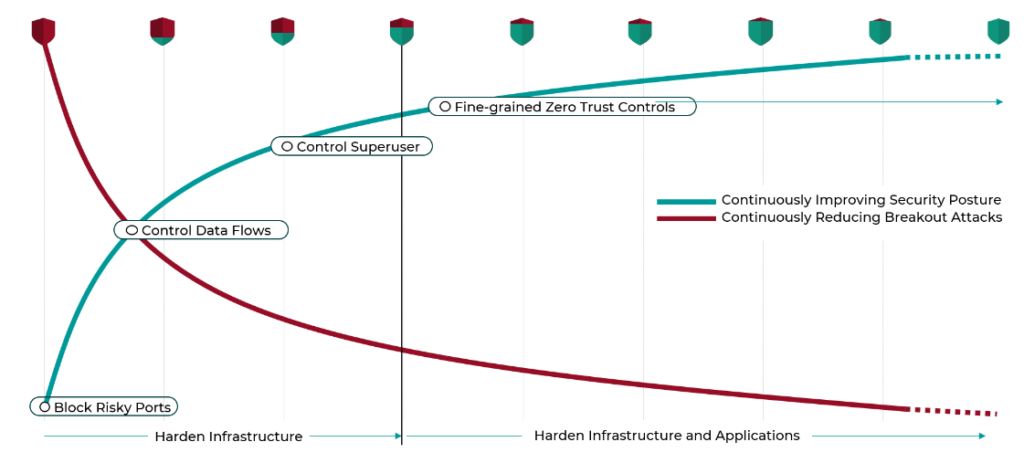
ColorTokens has transformed the microsegmentation implementation workflow, significantly accelerating the realization of security benefits. Traditionally, defining application-specific controls requires extensive collaboration among security, application, and infrastructure teams. In large enterprises with hundreds of applications, this can lead to prolonged delays in policy definition and testing, sometimes extending enforcement by months or even years.
Our groundbreaking approach prioritizes enterprise-wide controls for high-risk or unused ports, enabling organizations to achieve faster security enhancements soon after installation. By rapidly implementing essential security measures, ColorTokens empowers organizations to strengthen their security posture quickly and effectively, ensuring they are better equipped to counter emerging cyber threats.
Accelerated Time-to-Value Workflow of Xshield
2. Incremental Implementation Without Disruption
Incremental implementation enables organizations to enhance security without disrupting critical business operations. Administrators can progressively tighten traffic policies and test their effects, reducing the risk of service interruptions.
This method ensures essential applications remain accessible throughout the transition, maintaining operational continuity while progressively strengthening defenses against cyber threats. This strategic approach builds stakeholder confidence and fosters a security-aware culture, making teams more adaptable to evolving challenges.
Benefits of Progressive Enforcement
- Minimized Operational Impact: Ensures business continuity while gradually implementing security controls.
- Accelerated Security Benefits: Enables organizations to see tangible improvements shortly after implementation.
- Adaptive Policy Integration: Allows real-time policy adjustments based on evolving security needs.
- Enhanced Stakeholder Confidence: Provides immediate visibility into security enhancements for executive reporting.
Progressive Enforcement States
Progressive Enforcement consists of four enforcement states, each offering different security levels:
- Default Allow: All ports are open by default, allowing traffic to flow while administrators refine security rules. (Use with caution to avoid vulnerabilities.)
- Allow Open Ports: Existing open ports remain accessible during enforcement, ensuring uninterrupted communication between applications.
- Allow Active Ports: Ports that have been used in the last 30 days stay open to prevent disruptions to active services.
- Zero Trust: Blocks all ports unless explicitly permitted, aligning with the Zero Trust principle of “never trust, always verify.”
Conclusion
Progressive Enforcement empowers organizations to significantly enhance their security posture while safeguarding business continuity. By seamlessly integrating Zero Trust principles in an incremental manner, ColorTokens not only protects critical assets but also transforms security management. This innovative framework ensures rapid time-to-value, allowing organizations to realize immediate benefits while staying ahead of evolving cyber threats.
With ColorTokens, businesses can navigate the complexities of the digital landscape with confidence, setting a new standard in security excellence that delivers both resilience and efficiency.